Where did it Originate?
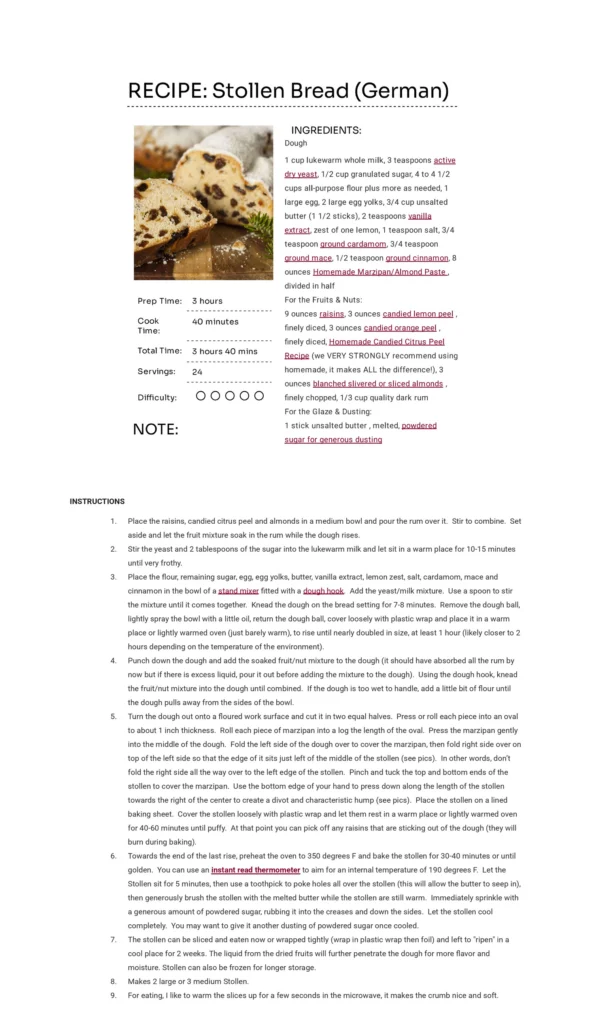
The first and most famous variety of stollen is the Dresdner Christstollen. Some historians date its concept back to 1329, and over the centuries the stollen was refined to become what it is today. And it has come a long way indeed because originally it was a bland and rather hard pastry as the use of butter and milk was forbidden during Lent by the Catholic church. Petitions were submitted to the pope, the first one in 1450, for permission to use butter for making the Stollen but it was denied. Fifty years and five popes later, Prince Ernst von Sachsen, at the request of the bakers of Dresden, petitioned the pope again to lift the butter ban. It was granted this time via the pope’s famous Butterbrief, “butter letter” – but only to members of the Prince’s household. A few select others were also granted permission but only on condition that they paid an annual sum of gold for the building of the Freiberg Minster.
The butter ban was once an for all lifted during the Protestant Reformation of the 16th century. From that point the stollen gradually developed into an enjoyable sweet bread incorporating additional ingredients and it become an important symbol of the region. King August II in 1730 commissioned the bakers of Dresden to bake a gigantic stollen in celebration of the strength of the Saxon military, an event to which he invited the dignitaries of Europe in the hope of building allies. The stollen weighed 1.8 tons (that’s 3600 pounds!), was 27 feet long and 18 feet wide and a special oven was designed and built just for this purpose. It took a convoy of eight horses to transport the stollen to the king’s table and a 26 pound and 5 1/4 foot-long knife was used to cut it.
Germany’s first Christmas market was held in Dresden in 1434. This market, the Dresdner Striezelmarkt, continues to be held every year. Also held annually on the Saturday prior to the 2nd Advent is the Dresdner Stollenfest featuring Germany’s largest Christstollen. So far 2013 holds the record for the largest Stollen weighing nearly 9400 pounds! Each year a horse-drawn carriage parades the giant stollen through the streets and on to the Christmas market. Per tradition, a replica of the original 5-foot long knife is used to slice the stollen. The mayor of the city tastes the first piece and the stollen is then cut into thousands of pieces that are sold with the proceeds going to charity.